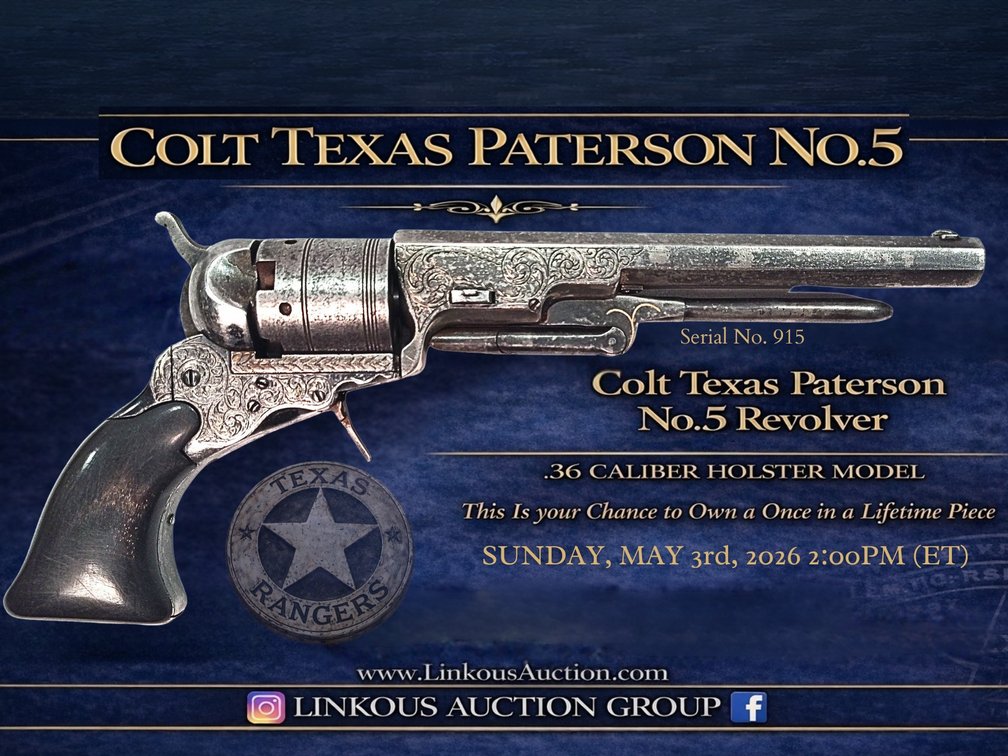
#1 • Colt Texas Paterson No. 5 Revolver
Part of Original Colt Paterson No.5 Texas Holster Model Revolver (live auction by Linkous Auction Group)
High bid $50,000.00
Status: Sold
Rare and Exceptionally Desirable Factory Engraved Colt No. 5 “Texas Paterson” Revolver with Loading Lever 36cal SN#915 All Bidding will be Virtual Online Live with Pre-Bidding Auction Ending Sunday, May 3, 2026 2:00 p.m. Auction Preview: By Appointment Only! Among the most iconic and coveted early American firearms, the Colt No. 5 “Texas Paterson” revolver stands as a cornerstone of both Colt history and the lore of the Texas frontier. Produced in very limited numbers, approximately 1,000 examples total and only about 200 with loading lever by Samuel Colt’s Patent Arms Manufacturing Company between 1838 and 1840, the No. 5 Holster Model represents the largest and most powerful of the original Paterson series. This model achieved legendary status through its association with Captain Jack Hays and the Texas Rangers, who relied on its firepower during the Republic of Texas era—indeed, the Republic itself was a significant purchaser. Its effectiveness in combat left a lasting impression on Samuel Walker, whose firsthand experience with the Paterson directly influenced his collaboration with Samuel Colt in developing the famed Colt Walker revolver of 1847. This innovation would, in turn, lead to the Dragoon series and cement Colt’s reputation in firearms history. Due to their hard use on the frontier, surviving examples of the No. 5 Paterson are exceedingly scarce, particularly those retaining original finish. Today, the model is regarded as one of the most important and desirable of all Colt percussion revolvers, prized not only for its rarity but also for its historical significance and frontier associations. Condition Fine overall. The 7.5in 36cal barrel is fitted with a German silver front sight and bears the classic roll-marked legend: “- Patent Arms M’g. Co. Paterson, N.J. – Colt’s Pt. –” adorned with “star & snake” motifs. The five-shot cylinder features the iconic stagecoach holdup scene and is marked “COLT.” The revolver is completed by a Buffalo horn grip and matching serial number “915” on major components, including the butt, cylinder, barrel lug, wedge, and collar. The barrel retains most of its original silver-plating finish, while the cylinder shows faint traces. The revolver exhibits an attractive, untouched patina with subtle blending into a pleasing silver-gray tone. The cylinder scene remains largely visible. Mechanically, the revolver remains in fine working order. Bore and rifling are in amazing condition for age. Providence This Colt Texas Paterson Model No 5 is from the collection of Tim Mercer. Mr. Mercer traded into it from a man who had held it for many years. He traded with his brother who had years earlier traded for it. Mr. Mercer traded a Whitneyville Walker toward this Texas Paterson. He has owned and traded a number of Walkers and with only approximately 200 Texas Patersons with lever made, this was an important addition to his collection of rare artifacts. Mr. Mercer has known both Jim Julia of James D Julia Inc. (“Julia”) and the Poulin family of Poulin Antiques & Auctions Inc. (“Poulin”) for decades. Mr. Mercer was close friends with J R Larue, former head consultant for Julia having spent much time together examining and authenticating Colts and other antique weaponry. Poulin’s current head consultant, Dave Sanders, also a friend of Mr. Mercer for decades, is well acquainted with Mr. Mercer’s experience and knowledge of antique Colts. In fact Mr. Sanders, who is contemplating retirement, is of the opinion that Mr. Mercer has the knowledge to assume his role should he have interest. Over the past many decades, Mr. Mercer has served as consultant for other auction houses and gun dealers. Metallurgical Testing and Analysis On January 5, 2026 an XRF metallurgical test and analysis was conducted on the subject Colt Paterson Model #5. The testing was conducted by Michael Sparagna who serves as the regional representative for fifteen states on behalf of Bruker Corporation (Nasdaq: BRKR). Bruker Corporation is one of the world’s leading analytical instrumentation companies and developed the Handheld XRF Spectrometer used in this analysis. Tests were conducted on the wedge, butt plate, cylinder rod, cylinder, cylinder nipple, main spring, barrel, and loading lever. Analysis of Steel Three periods of Steel making relevant to this analysis. Crucible Process Period - Traces its origins to the 1st Millennium CE with the development of the Wootz process in India and Sri Lanka. Bessemer Process Period - Developed in 1856 with first commercial use in England 1858. Dominant process in the US during the 1860s thru 1890s and gradually replaced by the Modern Open-Hearth Process around 1900. Modern Process Period - Developed in the 1860s and introduced to the US in 1868 with widespread use by 1900, replacing Bessemer Process. Its use was phased out in the US by the 1980s with the advent of new technologies such as Basic Oxygen Furnace and Electric Arc Furnace. Source of iron ore for steel making and impurities. At the time of manufacture, between 1838-1840, the local source of iron ore for steel most readily available to Colt Manufacturing was from the Salisbury region of Litchfield County in Connecticut. Salisbury ore was widely used and considered superior for tool making due to its: Low content of phosphors (P) (0.100-0.128%) High content of Manganese (Mn) (roughly 1.27%) with seams of Mn rich ore reaching levels as high as 25% and “Notes on the Samples of Iron Ore Collected for Analysis…”, and General lack of harmful impurities to the steel making process. The primary impurity was Sulfur (S) with Salisbury ores often containing high levels of sulfur (0.150-0.17%). Other impurities such as Molybdium (Mo) and Chromium (Cr) were in trace amounts in the hundredths of a percent. Test Results The samples showed: No measurable amount of Phosphorus (P), as expected. A high amount of Sulfur (S) that averaged 0.338% which is a magnitude of ten higher than would be expected for either the Crucible (<0.03%) or Bessemer (0.05%) processes. This anomaly will be discussed further below. The Crucible process was able to remove this unwanted sulfur through the binding of Manganese (Mn) found in the ore with the sulfur. The original Bessemer process would result in higher sulfur content in the steel, potentially making it brittle and unsatisfactory for use in firearms. This is because the original Bessemer converter used an acidic lining that could not remove sulfur effectively. This issue was made worse as the Bessemer process removed the Mn naturally occurring in the iron ore which otherwise could have assisted in removing the sulfur. This problem was mitigated in 1856 through the addition of Mn back into the steel using spiegeleisen (cast iron with 5-15% Mn). Spiegeleisen served as a deoxidizing agent to alleviate the brittleness indeed by the presence of sulfur and could be as high as 12-14% of the steel composition. It was not until 1879 with the addition of lime and a basic lining (the Thomas-Gilchrist process), which wasn’t part of Bessemer’s initial invention, that sulfur removal became effective. A small amount of Mn averaging 1.0641%. This is in line with naturally occurring levels found in Salisbury iron ore and a level to be expected with the use of the Crucible Process. As noted above, the Bessemer Process would be expected to produce steel containing much higher amounts of Mn, of at least 5% but generally higher. Trace amounts of Molybdium (Mo), averaging 0.0265%. This is expected in Crucible steel made in the period 1838-1840. Mo was not a recognized additive and was present only as an unintentional, naturally occurring trace impurity with levels in the hundredths of a percent. It was not until the turn of the century that it was understood that Mo reduced brittleness of the steel and using the Modern Process was purposely added in material amounts (0.40-0.65). Trace amounts of Chromium (Cr), averaging 0.0334. Prior to 1865, Chromium (Cr) was not known as a purposeful additive and was present in steel only as an impurity in trace amounts. Steels with 3.00-5.00% Chromium (Cr) were first made in 1865 to increase hardness and in the early 1900s the amount of Chromium was increased further to above 5.00% with the further understanding of its corrosion resistant-properties at those higher levels. Analysis of Silver Plating The test results indicate that a base of copper (Cu) (3.6845%) was laid and then plated with a thin layer of Silver (Ag) (0.5591%). There is only a trace amount of Zn (0.4753%) and Ni (0.2576%) present as impurities, not in sufficient quantity to indicate the use of German Silver which is composed of roughly 20% Ni-60% C-20% Zn or Brass which is roughly composed of 70% Cu and 30% Zn. As previously noted, the test results for S averaged 0.338%, which is too high to be an impurity left by any of the processes. Rather it is more likely an indication of use and insufficient cleaning of the gun as SO2 is an acidic surface residue created by firing black powder. Consistent with this, the Silver plate is tarnished. Additionally, the Cu base is showing the effects of corrosion. More generally, the silver plate is aging as expected of a nearly 200 year old gun having developed a dark gray to black tarnish which has even made its way into the deep recesses of the engravings and exhibiting some unevenness of the silver plate on the grip straps which are high-wear areas. Analysis of Inlay There are inlays on either side of the loading lever. The test sample confirmed that the inlays are Gold (Au) 10.3134%. Analysis of Engraving Frederick Hanson was the master engraver at the Colt Paterson Manufacturing Co. and his work was reserved for the high-end exhibition pieces and presentation models. Richard Henshaw the principal engraver who oversaw all of the factory engravers and the general quality of engraving for standard production pieces. Henshaw established the floral and scroll patterns used on many standard Paterson models in the style of that found on this piece. Due to a lack of factory records only Hanson and Ormsby are named in this group of factory engravers. As the silver plating is consistent with methods employed at the Colt Paterson factory and engraving is completed before plating, it is reasonable to attribute the engraving to one of these unnamed engravers under Henshaw’s charge. Summary The opinion drawn from the analysis of these test results is that this gun is authentic with production late in the later half of the 1838 to 1840 production run. The test results support the likely use of iron ore from the Salisbury Mines, the Crucible Process, factory engraving, and factory silver plating. This testing was conducted in a manner to assure accuracy and repeatability of the results by an experienced user of the Bruker XRF analyzer. Additionally, analysis of the test results relied on conclusions drawn from comparisons of those results with relevant historical public data. Historical Significance The Colt Paterson revolver, patented in 1836, was pivotal for Texas, providing the Republic’s navy and Rangers with necessary, superior rapid-fire capability against Comanche forces and Mexican soldiers. Primarily used by Jack Hays' Texas Rangers in the late 1830s and early 1840s, these five-shot, .36 caliber "Holster" models allowed for increased firepower. Although the Paterson's use post-dates the main 1835-1836 Texas Revolution, it was instrumental in defending the young Republic during the immediate, volatile, post-independence years. The Republic of Texas ordered 180 of the revolvers for the Texas Navy in 1839. When the navy was disbanded, these guns were transferred to the Texas Rangers who were greatly advantaged by the Paterson's use in the frontier warfare with the Comanches. The Rangers used them to great effect to counter Comanches, who could fire multiple arrows in the time it took to reload a traditional single-shot pistol. Major engagements in which these revolvers were used included the Council House Fight (1840), the Texan-Santa Fe Expedition (1841), and the Battle of Salado Creek (1842). The Paterson was particularly effective in the 1844 Pedernales River fight and the Battle of Bandera Pass. A cornerstone piece for the advanced Colt collector, the No. 5 Texas Paterson is widely regarded as essential for a truly complete collection. Opportunities to acquire such a historically significant and seldom-encountered example—especially one engraved and with the loading lever— are exceedingly rare.